


Choose cloud vs on-premise eClinical infrastructure by matching trial requirements to demonstrable controls, your team’s operating capacity and lifecycle cost. Neither model is inherently compliant or secure. For a contract research organisation (CRO), the stronger option is the one whose responsibilities, evidence and continuity arrangements remain workable throughout the study.
Infrastructure decisions affect how quickly teams support new studies and how reliably they maintain records. This comparison covers deployment, compliance, validation, costs and the conditions that make each model appropriate.
What is the difference between cloud and on-premise eClinical infrastructure?
Cloud infrastructure uses remotely delivered computing services, while on-premise infrastructure runs within facilities managed by the organisation or its appointed operators. Browser access alone does not establish which model a system uses.
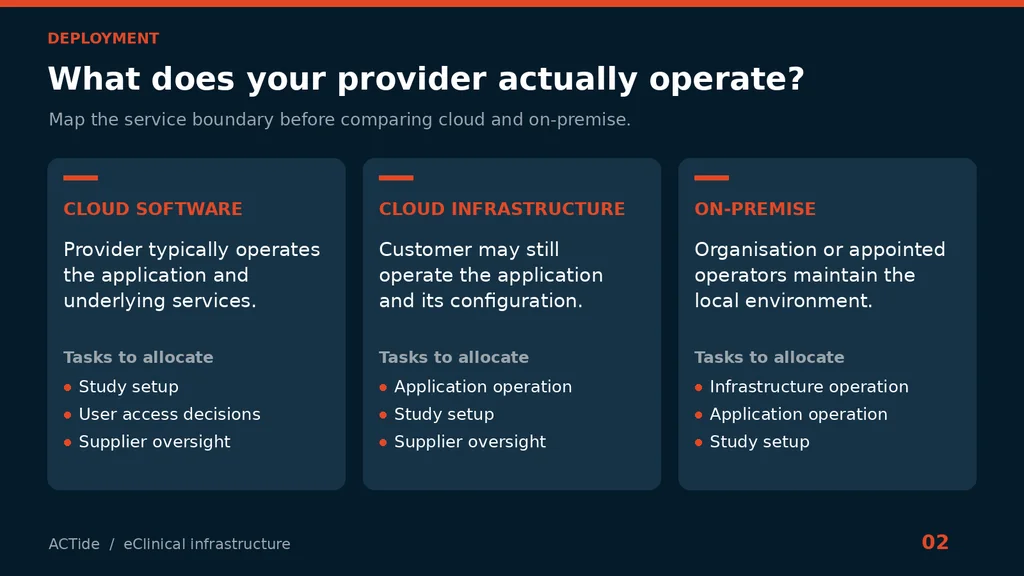
Cloud-based eClinical solutions also differ in service scope. Software as a service generally includes application operation; renting cloud infrastructure can leave application management with the customer. The European Medicines Agency (EMA) guideline, 2023, section 6.7 explicitly covers different cloud service models.
For either option, document who patches systems, manages accounts, approves changes and restores data. For example, a CRO can outsource hosting while retaining responsibility for study configuration and user access decisions.
Does cloud or on-premise comply with GxP, 21 CFR Part 11 and GDPR?
Either model can support compliance when the applicable controls are implemented and evidenced. GxP refers to the relevant good practice requirements; clinical trials require good clinical practice (GCP).
21 CFR Part 11, section 11.10, reviewed in 2026, addresses controls including authorised access, audit trails and record protection for applicable closed systems. A hosting location cannot establish compliance with those requirements.
The General Data Protection Regulation (GDPR), Regulation (EU) 2016/679, requires appropriate processing arrangements and security. Assess controller and processor roles, subprocessors and access locations. The European Data Protection Board explains international transfer requirements: European hosting alone does not resolve access by a separate organisation outside the European Economic Area.
Who is responsible for computer system validation in each model?
The sponsor retains ultimate responsibility for its trial activities, including data reliability, when validation work is transferred to providers. The CRO’s assigned activities and the provider’s deliverables must be documented.
ICH E6(R3), 2025, Annex 1, sections 3.6 and 4.3 addresses service-provider oversight and computerised systems. The Food and Drug Administration (FDA) guidance, October 2024, questions 7–9 recommends risk-based validation and supporting documentation; the guidance itself is nonbinding.
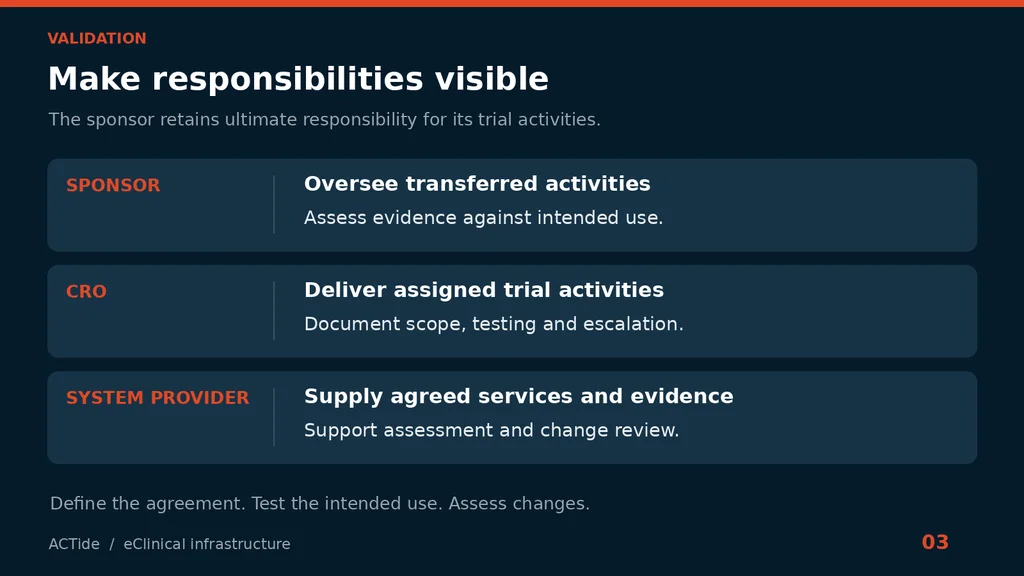
Assess supplier evidence against intended use, then test study-specific configurations and workflows through user acceptance testing. Maintain change assessment throughout operation.
A concrete ACTide example is Nubilaria’s validation service, which includes gap analysis, remediation planning and training, with system validation and audit support in its full-service offer. These activities support a defined validation scope; they do not remove sponsor oversight.
How do total costs compare between cloud and on-premise?
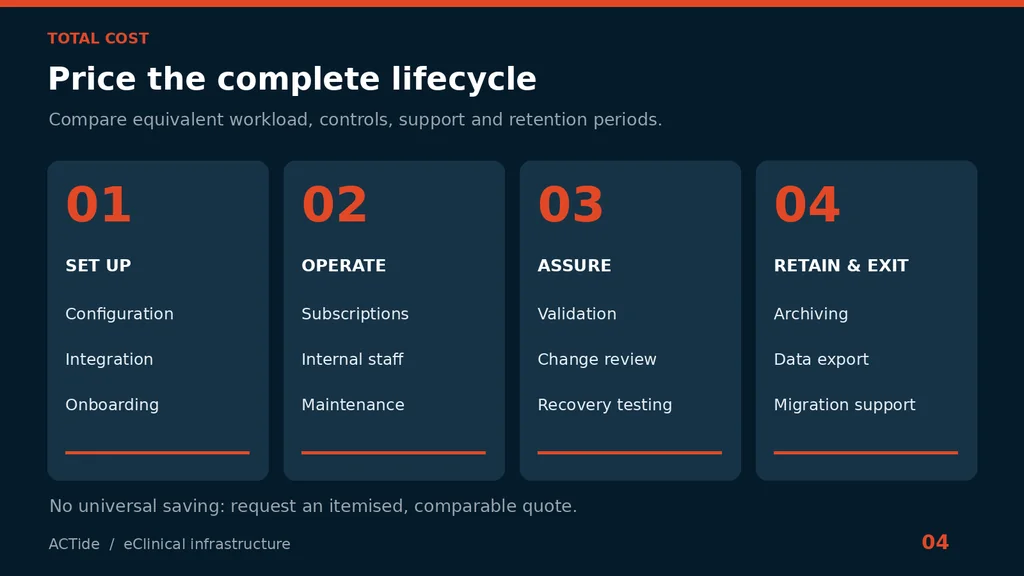
Total cost depends on the service scope, workload and retention period; neither model is always cheaper. Compare equivalent controls and support over the same study portfolio and time horizon.
| Cost area | Cloud assessment | On-premise assessment |
| Initial setup | Configuration, integration, onboarding | Equipment, installation, configuration |
| Operation | Subscription, support, usage limits | Staff, maintenance, power, licences |
| Assurance | Supplier review, testing, change assessment | Infrastructure qualification, testing, change assessment |
| Continuity and exit | Recovery terms, exports, archive fees | Recovery facilities, refresh cycles, archive operation |
Request an itemised quote and model study growth, prolonged retention and contract termination. Include staff time: work absorbed by an existing team still consumes capacity. Avoid assuming subscription pricing includes every integration or inspection request.
When does on-premise still make sense, and when is cloud the better choice?
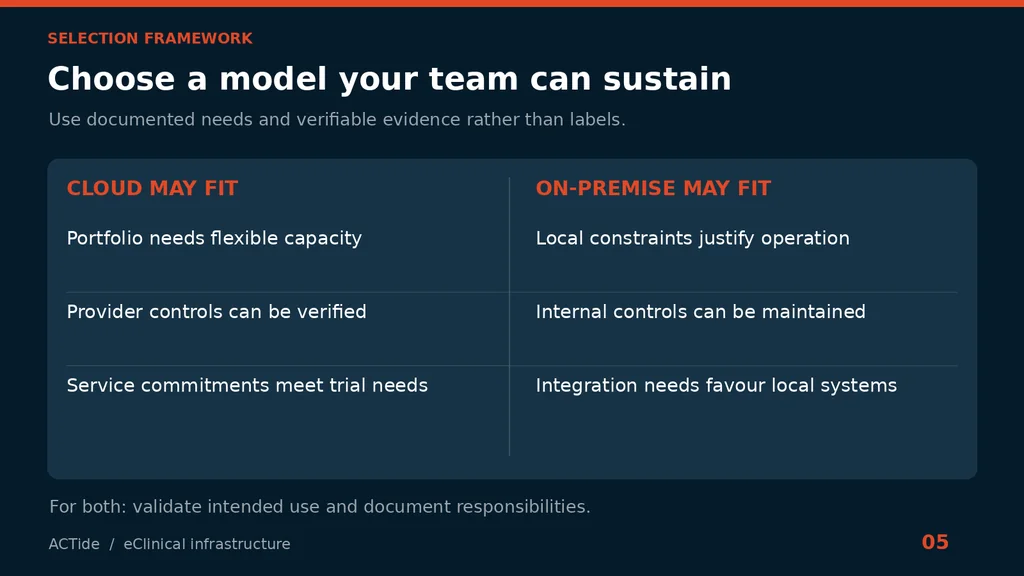
On-premise can make sense where documented institutional constraints or integration needs justify local operation and a capable team can maintain it. Cloud can be preferable when studies need flexible capacity and the provider can demonstrate suitable controls and service commitments.
For a CRO adding sites, assess provisioning, connectivity, support coverage and change notification. For an established local environment, assess whether maintaining infrastructure competes with study delivery.
ACTide eCRF, an electronic case report form system, provides online audit trails and real-time exports. The ACTide Ecosystem adds self-service administration; ACTide services offer self-configuration, shared delivery or full-service support. Evaluate operational autonomy separately from hosting, and confirm deployment terms during procurement.
Choose the infrastructure your organisation can govern throughout the trial and retention period. Document responsibilities, validation evidence and complete costs before committing.
Request an ACTide demo to discuss your CRO’s workflows, validation needs and operational requirements.