


Decentralized clinical trials bring selected study activities closer to participants: at home, through local healthcare providers or using remote technology. They do not remove the investigator’s responsibility for participant safety or reliable evidence.
For CROs, the conversation has moved beyond pandemic contingency planning to deliberate protocol design. The question is which activities can move away from the site without weakening oversight. Understanding the state of the art in decentralized clinical trials, and the enabling tools, starts with that decision.
The current regulatory state of the art
The FDA’s final Digital Health Technologies for Remote Data Acquisition guidance, issued in December 2023, addresses selecting and using technologies to collect data remotely. A wearable needs evidence that it is suitable for its intended measurement and population.
The September 2024 final guidance, Conducting Clinical Trials With Decentralized Elements, covers operational responsibilities, remote visits and investigational products. FDA guidance provides recommendations; it does not replace binding regulatory requirements.
In Europe, ICH E6(R3) Annex 2 reached Step 4 on 3 June 2026. EMA lists 15 January 2027 as its EU effective date. It addresses decentralized, pragmatic and other non-traditional trial elements alongside the Principles and Annex 1.
The European Commission, HMA and EMA recommendations on decentralized elements, updated in October 2025, add practical context. CROs must still check national conditions for consent, home procedures and medicine delivery.
Fully decentralized or hybrid: what does adoption mean?
A fully decentralized trial conducts all trial activities away from traditional sites. A hybrid model combines remote activities with site visits, preserving physical assessments where clinically necessary.
For a drug study, that may mean hospital dosing and imaging alongside home symptom reporting. “More remote” is not automatically better: the protocol, product risks and participant needs determine the appropriate mix.
What percentage of clinical trials use decentralized elements? No single figure reliably describes every trial type and geography. A 2026 PLOS Digital Health analysis examined 1,370 keyword-identified trials starting between 2000 and 2023. It describes a heterogeneous, developing landscape, not a global adoption percentage. Likewise, claims that ePRO appears in a large majority of DCTs need a defined dataset.

The enabling technology stack
ePRO and eCOA
Electronic clinical outcome assessments include patient-reported outcomes. ePRO captures symptoms and treatment experiences directly from participants between visits. Questionnaire suitability, completion windows and missing-data handling matter as much as the interface.
eConsent and telemedicine
Virtual visits support appropriate remote interactions, with clear escalation routes when examination or urgent care is needed. eConsent supports information delivery and consent documentation; participants still need opportunities to ask questions. Remote electronic signatures require country-specific review.
Remote data capture and wearables
Connected devices can capture measurements outside the clinic. CROs should assess usability, measurement performance, connectivity, timestamps and data provenance. A sensor output becomes a useful endpoint only when its interpretation and measurement properties support the study objective.
Request an ACTide demo to explore ePRO, eCRF, RTSM and eConsent workflows against your next hybrid trial’s requirements.

The solution: an open and integrated eClinical ecosystem
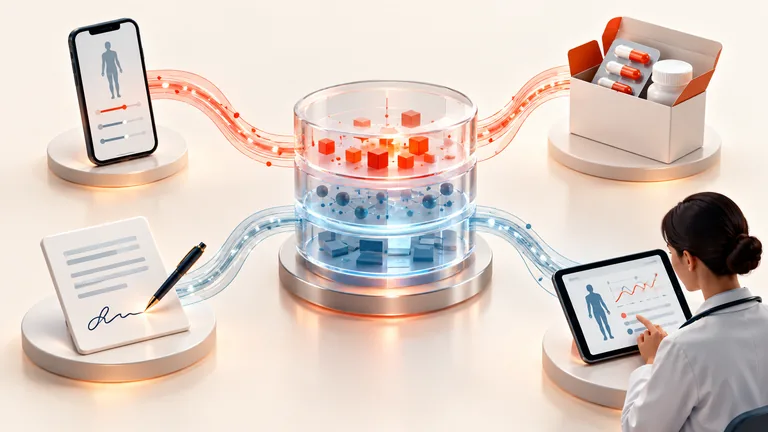
How does an integrated eClinical platform support DCTs? It connects participant inputs with clinical data and operational workflows, helping teams follow information across remote and on-site activities.
Separate eCOA, consent, RTSM and safety systems can multiply interfaces, identifiers and reconciliation tasks. A unified approach can reduce these handoffs, but CROs should verify access controls, audit-trail coverage, exception handling and validation responsibilities across the actual configuration.
ACTide ePRO stores patient-reported data directly in the eCRF database, connecting remote collection with ACTide eCRF. ACTide’s published eConsent overview describes integration with eCRF and ePRO. ACTide RTSM supports randomization and trial-supply workflows, including home resupply configurations where permitted.
Before choosing a stack, ask vendors to demonstrate one participant journey, including a missed assessment, consent update and supply exception. These moments reveal whether integration supports daily operations.
For example, if a remote symptom report requires clinical review, the team needs a defined route from submission to assessment and documented follow-up.
A shared database helps, but the operating process must also specify responsibilities and response expectations. Integration should make that process visible rather than leave staff to reconstruct events across exports and emails.
Patient engagement, recruitment and retention
What are the benefits of decentralized clinical trials? Fewer journeys can reduce participation burden and make research more accessible to rural communities, people with limited mobility and geographically dispersed rare-disease populations.
Access alone does not guarantee recruitment or retention. Unreliable connectivity, difficult interfaces and excessive questionnaires can shift work onto participants and caregivers.
Build practical support into the protocol:
- Offer onboarding and a reachable human contact.
- Provide suitable alternatives for participants without compatible devices.
- Review missed assessments early and agree proportionate follow-up.
- Keep privacy information understandable; explore decentralization and clinical-trial data protection when mapping data flows.
Design connected trials around real needs
Decentralized elements are an established design option, with suitability assessed study by study. Effective delivery combines participant support, accountable oversight and connected data workflows.
Request an ACTide demo to explore ePRO, eCRF, RTSM and eConsent workflows against your next hybrid trial’s requirements.