

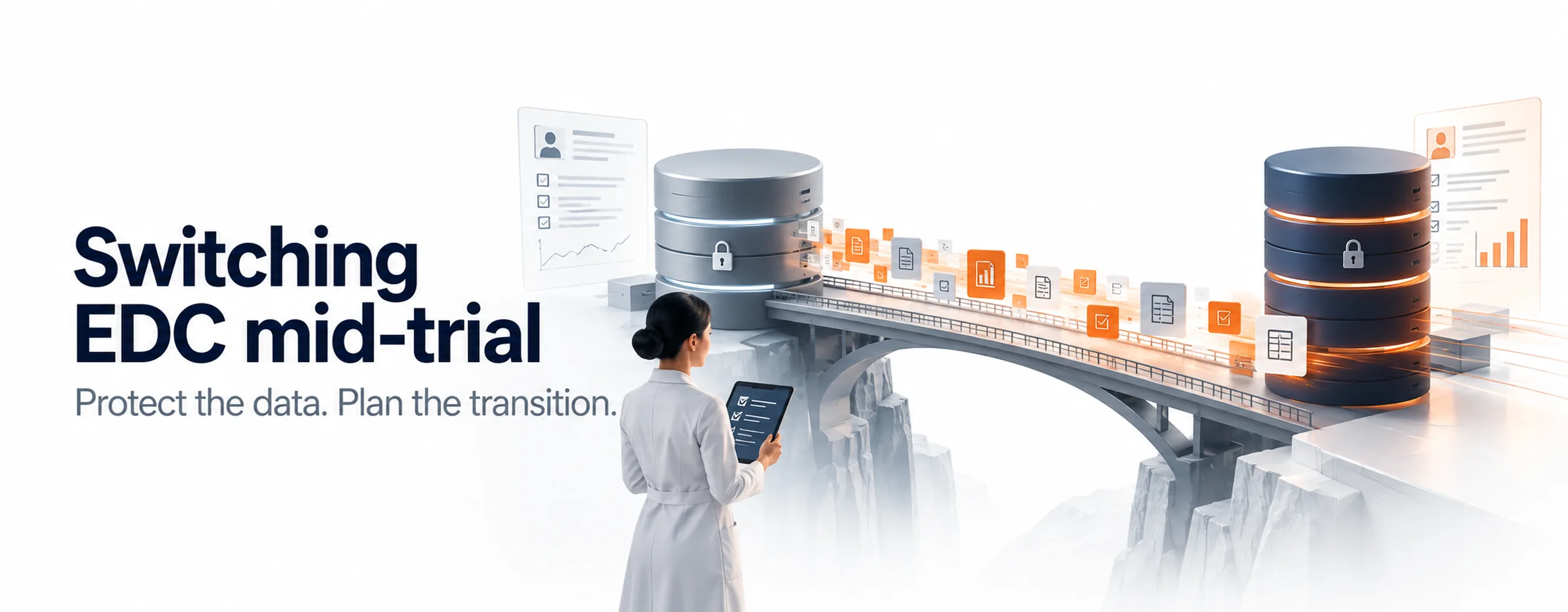
Switching electronic data capture (EDC) platforms during an active trial can become necessary when support deteriorates, amendments stall or costs escalate. For a CRO, the decision affects sites, data managers, monitors and the sponsor simultaneously.
When assessing switching EDC platforms mid-trial, risks and costs extend beyond moving records. The central question is whether the study can continue with trustworthy data and a defensible history. A better interface alone is insufficient justification.
Why sponsors consider switching EDC mid-study
A legacy platform may struggle with repeated visits, complex forms or protocol amendments. Slow change requests can leave sites using workarounds while the study team waits for vendor support.
Commercial pressure also matters. Rising fees, restricted exports and dependence on vendor configuration can create lock-in. Before replacing the system, compare remediation, a negotiated support plan and migration against the remaining trial duration.
Document the problem in operational terms: unresolved queries, delayed amendments, downtime or extra site workload. This gives the sponsor a decision basis beyond frustration.
What are the risks of switching EDC systems mid-study?
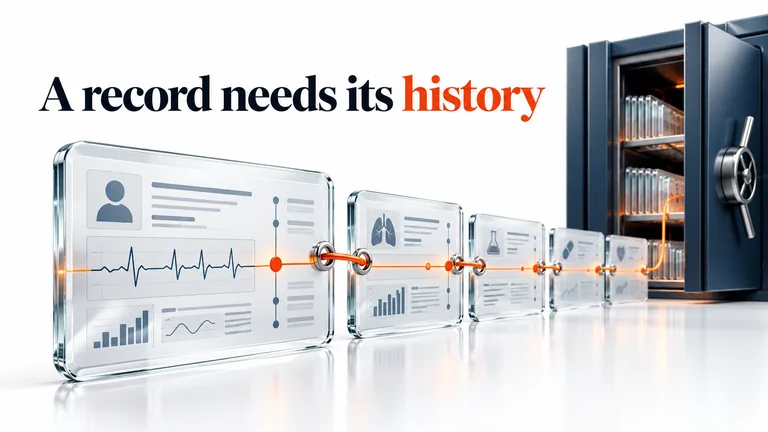
The greatest risk is losing context. A value can transfer correctly while its units, query history, signature status or original timestamp disappears. Manual recreation can introduce errors and make imported records look newly collected.
The EMA guideline on computerised systems and electronic data in clinical trials addresses migration specifically in section 6.10. It expects detailed planning and validation that protects existing data and metadata.
Validation also continues after initial deployment. FDA’s final October 2024 guidance on electronic systems, which finalised the March 2023 draft, recommends evaluating and validating changes throughout the system lifecycle according to risk.
Sites face practical disruption: unfamiliar workflows, temporary access restrictions and additional reconciliation. Monitoring can become inconsistent if review flags or open queries are handled differently.
How does switching EDC systems impact regulatory inspections? The transition creates additional evidence to examine: change control, validation, record history and the ability to reconstruct the study.
How much does it cost to switch EDC platforms?
There is no defensible universal price. The scope depends on study complexity, record volume, metadata availability, integrations and the remaining timeline.
Build a budget around:
- Extraction, mapping, transformation and reconciliation.
- Study configuration and interface testing.
- Validation evidence, approvals and documentation.
- Site training, helpdesk support and coordination.
- Overlapping licences, archive access and vendor exit fees.
Include internal hours as well as supplier quotations. A cheaper licence can still produce a more expensive transition.
IQ/OQ/PQ activities may form part of the validation strategy, but neither their repetition nor a fixed package should be assumed universally mandatory. Define testing from intended use, change impact and risk.

How to migrate without compromising data integrity
Can data integrity be maintained when migrating to a new EDC? Yes, provided preservation is demonstrated through controlled processes and evidence, rather than assumed from a successful import.
Plan the transition before moving records
Assign sponsor and CRO responsibilities. Inventory data, metadata, configurations and connected systems. Agree acceptance criteria, a controlled entry freeze, urgent safety workflows and a rollback decision point.
Create a source-to-target mapping for forms, visits, identifiers, code lists and edit checks. Reuse compatible configuratins where feasible, but test their behaviour; matching field names does not establish equivalence.
Rehearse and reconcile
Run a representative test migration. Challenge missing values, amended forms, repeated visits and timezone differences. Compare record counts and critical values, investigate exceptions and document transformations.
Test user permissions and integrations alongside data. Train sites before cutover and provide support when new entry resumes. Maintain one clearly designated system for each active workflow.

Preserve evidence after cutover
Keep original audit trails accessible and link imported records to their legacy identifiers. Do not represent migration timestamps as original collection timestamps. Preserve signature context and establish how subsequent approvals will work.
21 CFR Part 11 record controls address accurate copies, retention and audit trails. ACTide’s practical guide to electronic signatures provides additional context.
Approve the migration report and define archive ownership, retrieval testing and decommissioning criteria. Keep inspection evidence organised using the considerations in ACTide’s eTMF selection guide.

Choose an EDC that reduces future switching risk
During selection, ask vendors to demonstrate an amendment on a populated test study. Examine version control, export completeness, support commitments and exit provisions before signing.
An integrated ecosystem can reduce interface fragmentation, although dependencies still require assessment. Explore ACTide eCRF alongside ACTide RTSM and the wider ACTide eClinical ecosystem to discuss how collection, patient reporting, supply management and documentation fit your study.
Request an ACTide demo using your amendment and integration scenarios to evaluate fit before committing.
Make the switch a controlled study decision
Switching can be justified when staying creates greater risk. Success depends on documented decisions, validated processes, preserved history and prepared sites.
If your CRO is evaluating alternatives, request a demo to discuss your study requirements with ACTide.