


Why standardized medical coding matters for CROs
One site records “feeling sick.” Another records “nausea.” Medication names vary across countries. Before a CRO can compare these records, it needs a consistent way to represent the clinical concepts and medicines reported.
Standardized medical coding maps original descriptions to controlled terminology while preserving the source text. MedDRA and WHODrug integration connects that process with clinical data collection, review and analysis.
For CROs, the practical benefit is clearer safety reporting and fewer inconsistencies reaching database lock. Reliable coding supports regulatory readiness, but dictionaries alone cannot guarantee compliance. Source quality, documented decisions and qualified review remain essential.
MedDRA and WHODrug cover different information
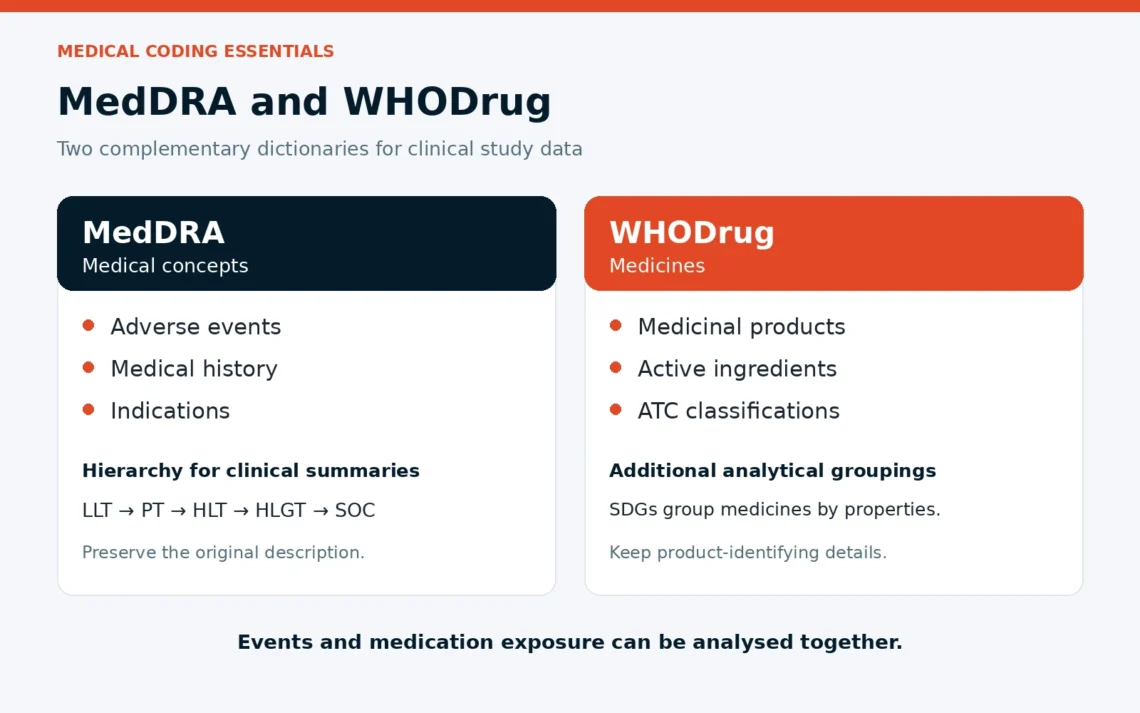
Is MedDRA medical coding? MedDRA is the Medical Dictionary for Regulatory Activities; medical coding is the process of selecting its terms. It covers adverse events, medical history, indications and other medical information.
WHODrug Global, maintained by Uppsala Monitoring Centre, identifies medicines and their active ingredients. It helps teams reconcile brand names and analyse concomitant medication use.
The difference between MedDRA and WHODrug is straightforward: one describes medical concepts; the other describes medicines. Studies collecting both adverse events and medication exposure commonly use both.
Their selection should follow the study’s data requirements and intended submissions.
Request an ACTide demo to discuss medical coding support, data controls and safety reporting around your CRO’s requirements.
How medical coding works in practice
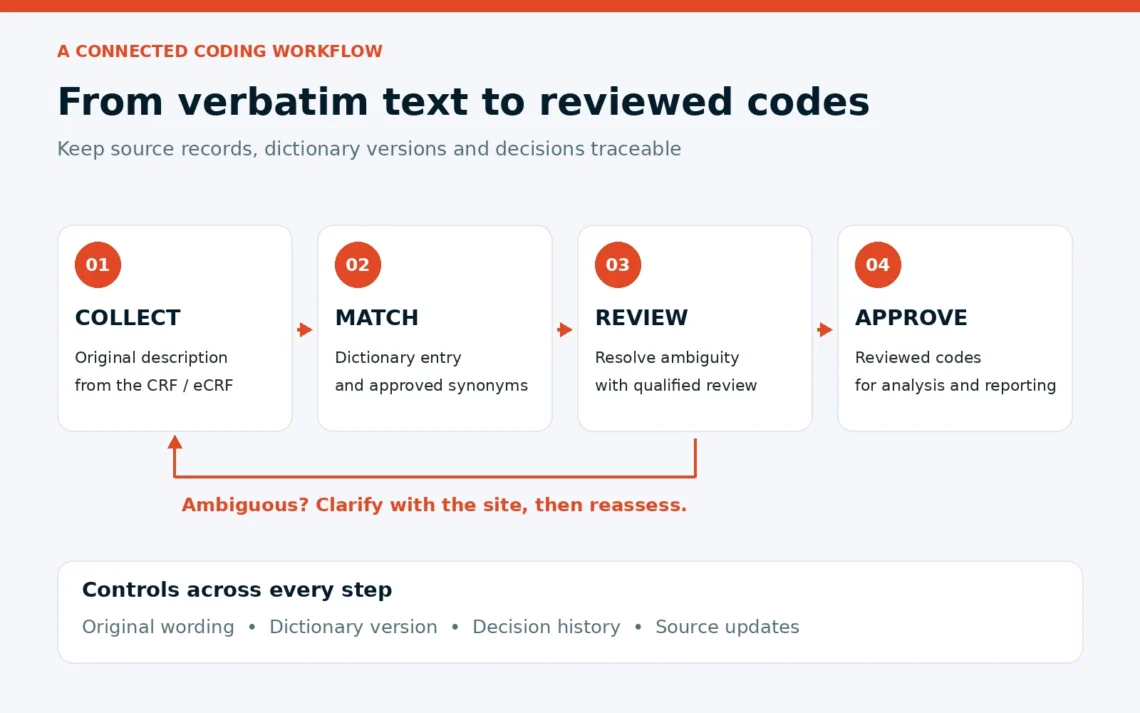
Coding starts with verbatim terms collected in CRFs or eCRFs. A coder selects the dictionary entry that accurately reflects the reported information. Ambiguous wording needs clarification rather than an assumed diagnosis, as explained in MedDRA Term Selection Points to Consider.
For example, “joint inflammation” can map to the corresponding MedDRA LLT and roll up to the PT “Arthritis.” The original wording stays available.
For medicine, the reported name may need country, strength or formulation details to identify the correct product.
Understanding codes and groupings
What are MedDRA codes? They are eight-digit identifiers attached to terms. Coding normally selects a current Lowest Level Term (LLT), linked to a Preferred Term (PT). The MedDRA hierarchy also includes High Level Terms (HLT), High Level Group Terms (HLGT) and System Organ Classes (SOC), supporting broader summaries.
WHODrug links medicinal products to ingredients and Anatomical Therapeutic Chemical (ATC) classifications.
WHODrug Standardised Drug Groupings provide additional groupings based on shared properties, such as pharmacological effects. These support targeted medication analyses rather than replacing ATC.
Choosing and controlling dictionary versions
A WHODrug version identifies a dated release, not a separate dictionary. Record the release and format used for each study, alongside the MedDRA version.
Updates can affect available terms, relationships and analyses, so assess their impact before changing an ongoing study.
Request an ACTide demo to discuss medical coding support, data controls and safety reporting around your CRO’s requirements.
Why integration into the EDC matters
Disconnected coding files create opportunities for stale records and missed updates. A connected workflow should carry source changes into coding review and return approved codes with traceable decisions.
Automatic coding engines can resolve exact matches and approved synonyms. Manual review remains important for ambiguous descriptions, unfamiliar products and exceptions. A high automatic match rate says little about accuracy unless the matches are checked.
CROs should monitor how long exceptions remain unresolved and which sites generate repeated clarification requests. These measures help identify whether the bottleneck lies in collection, review capacity or coding conventions, and guide corrective action before the backlog grows.
Where configured, real-time consistency checks can identify missing medication details early. Resolving these gaps while sites can clarify them may reduce repeated queries later.
ACTide Data Manager Tools and Services combines background data controls, data integration and medical coding support using MedDRA and WHODrug.
Regulatory relevance and CDISC standards
The FDA Study Data Technical Conformance Guide addresses MedDRA for adverse events and WHODrug Global for concomitant medications, including versioning and dataset conventions.
In Europe, EMA’s EudraVigilance system uses MedDRA for medical terminology. Avoid assuming every authority requires both dictionaries for every submission: requirements depend on jurisdiction, product and submission type.
CDISC SDTM structures the submitted data; dictionaries standardize relevant values within it. Adverse event and concomitant medication datasets must retain the appropriate relationship between collected and coded information.
Our guide to CDISC standards explains how these standards support clinical data exchange.

Best practices for reliable coding
Agree responsibilities before recruitment starts. Data management, pharmacovigilance and biometrics need shared conventions so that coding decisions support both case review and statistical reporting.
- Maintain approved synonym lists with review history; avoid reusing mappings without checking context.
- Assess dictionary upgrades for changed terms, hierarchy links and medication classifications.
- Define when recoding is needed, obtain approval and retain the original decision history.
- Reconcile relevant clinical and safety records, and track unresolved coding before lock.
The ACTide Safety Tool supports configurable study reporting and comparison of data snapshots. These capabilities can help teams review evolving safety information alongside their coding procedures.
Build coding quality into your study workflow
Standardized medical coding makes clinical data easier to compare and explain. MedDRA and WHODrug integration delivers value when source records, dictionary versions and review decisions remain connected throughout the study.
For your next trial, request an ACTide demo to discuss medical coding support, data controls and safety reporting around your CRO’s requirements.